Software Development Cost in Kenya (2026): What Businesses Should Budget

Pricing note: The published amounts are Statum starting prices, not a complete quote. The public pricing page does not state whether VAT is included. Before budgeting, ask for a written proposal that specifies VAT treatment and whether hosting, third-party charges, data migration, post-launch support, and maintenance are included or billed separately.
Software development cost in Kenya depends on what the software needs to do, what it must connect to, and who will maintain it after launch. As a starting point, Statum currently lists MVP development from KSh 150,000+, custom business systems and ERP from KSh 500,000+, and enterprise integration or fintech projects from KSh 1,000,000+. These are Statum's published starting prices. They are not national market averages or a quote for a specific project. The final price depends on a written scope. You can see the current Statum service pricing before preparing a brief.
What those starting prices mean
A starting price is useful for an early budget conversation. It does not tell you the price of every product in that category. Two projects called an MVP can have very different numbers of screens, user roles, integrations and testing needs. A simple internal tool and a public platform with payments are not the same scope, even if both are described as a first release.
| Project type | Statum published starting point | What to clarify |
|---|---|---|
| MVP development | From KSh 150,000+ | Statum describes core features, a clean UI and standard authentication. Which workflow must the first release complete? |
| Custom business system or ERP | From KSh 500,000+ | Statum describes complex logic, multiple user roles and reporting dashboards. Which processes and data must it support? |
| Enterprise integration or fintech | From KSh 1,000,000+ | Statum describes integrations, transaction workflows, access requirements and operational work. Which providers and controls are required? |
Treat these figures as Statum's own published entry points, checked on 19 September 2026. They are not a survey of what every Kenyan developer charges. Ask for a written estimate against your requirements, including what is included, what is excluded and how changes are handled.
What affects software development cost?
The main cost drivers are decisions in the project scope. A short feature list is not enough to price a system reliably. The details below help explain why two similar-looking requests can produce different proposals.
1. Workflows and features
Start with the work people need to complete. A request and approval process may need a form, an approver, a status and an email alert. A more complete version may include multiple approval levels, deadline reminders, document uploads, exception handling, dashboards and an audit history. Each extra rule needs to be designed, built and checked.
It helps to describe a normal task from beginning to end. For example: who starts it, what information they enter, who reviews it, what happens when it is rejected, and what record must remain afterward. Clear answers reduce rework during development.
2. Users, roles and permissions
A system for one team may be straightforward. A system used by customers, staff, managers and finance teams needs different views and access rules. Sensitive actions may need extra checks or an approval trail. List the user groups and the information each group should be able to see or change.
3. Integrations and existing data
Connecting to a payment provider, accounting platform, SMS service or another business system can add work. The team needs to confirm that the service has a usable API, agree on what data moves in each direction, handle failures and test the connection. Moving information from spreadsheets or a legacy system also requires cleaning, mapping and validation.
Third-party charges are often separate from development fees. Confirm who pays for API usage, SMS, email, payment processing and other external services.
4. Design, security and reliability
The cost changes with the devices and browsers supported, the number of screens, the amount of custom design and any accessibility requirements. A public-facing service may also need stronger account protection, audit records, backup and recovery plans, performance testing or security review. Name these requirements early so they appear in the estimate.
5. Testing, launch and support
A launch plan can include importing initial data, training staff, preparing user guides and monitoring the first weeks of use. Ask which tests are included and how defects are handled after launch. Ongoing maintenance, new features and a response-time commitment may be priced separately from the initial build.
Three example project scopes
These examples are for planning and discussion. They are not Statum quotations or fixed packages. The same idea can become a much larger project when requirements expand.
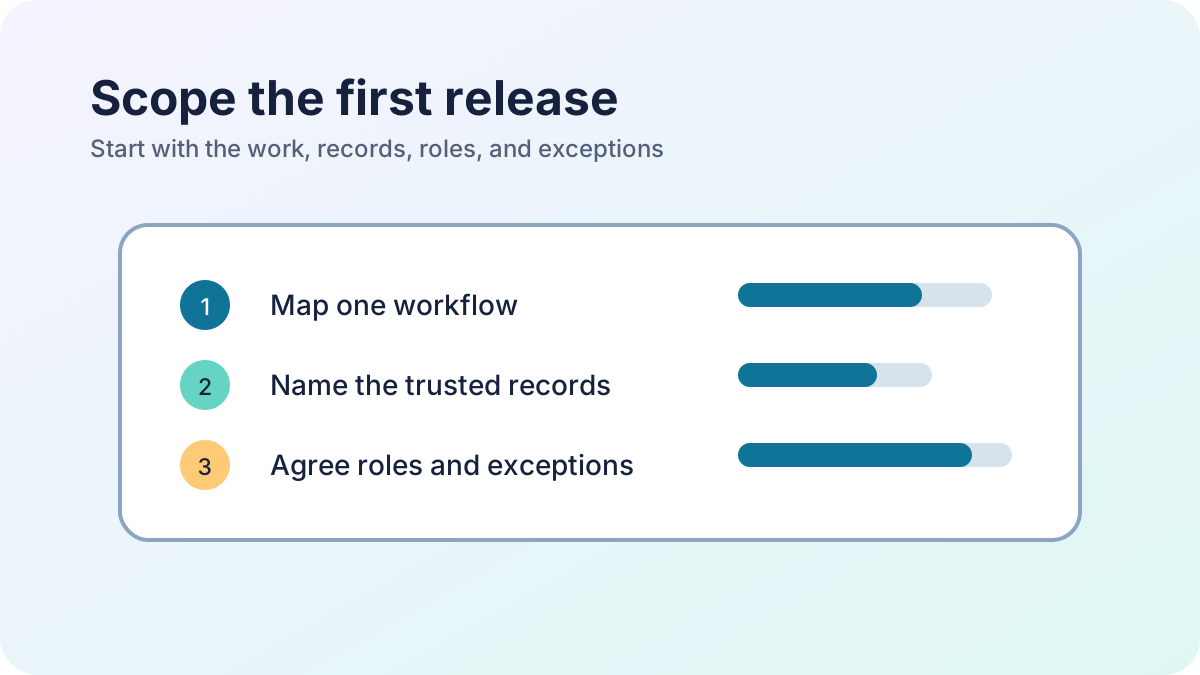
A first release for one internal workflow. A team wants to replace email approvals with a web form, a review step, status tracking and a basic report. The first version serves one department, uses existing staff accounts and does not move historical records. A brief like this is easier to estimate than a request to automate every department at once. The useful decision is which steps must be included on day one and which can remain manual for now.
An operations system for several teams. A business wants to manage customers, jobs, staff assignments and approvals in one place. Managers need reports, staff have different permissions, and existing records must be imported. It may also need a connection to an accounting or messaging service. The estimate should explain the data migration, integration limits and which reports are included.
A financial product or enterprise integration. A service needs to connect to external providers, record transactions, reconcile failed or reversed payments and give support staff a traceable history. The team may need stronger access controls, monitoring, security checks and a more detailed launch plan. Provider rules and test environments can affect both effort and timing.
Writing down these differences gives a developer something real to estimate. Statum describes its custom software development service and engagement options on its website.
Include the first year of ownership in your budget
The build is only one part of the cost of running software. Ask for a budget for the first year that includes the one-time project fee and any costs that recur or vary with usage. These can include:
- Cloud hosting, database storage, backups and monitoring
- Third-party services such as SMS, email, payment processing or maps
- Maintenance, security updates and bug fixes after the agreed warranty period
- Support hours and the response time for urgent issues
- Staff training, data cleanup and the time of an internal product owner
- Planned improvements after people begin using the first release
Some projects will not need every item. Ask the provider to say which services are included in the quote, which are billed separately and who owns each account. If support is offered as a monthly retainer or service agreement, ask what work and response times it covers.
When should you buy an existing product instead?
Before commissioning custom software, check whether an existing product can support the workflow with configuration. Buying or adapting a suitable tool is often a sensible choice when the process is common and the product already meets your reporting, access and integration needs.
Custom development can make sense when an important process does not fit available products, when several tools need to share data reliably, or when the software itself is part of the service you offer customers. There is also a middle option: configure an existing platform and build only the connection or workflow that is missing.
Be specific about the problem before choosing. If spreadsheets are creating delays, errors or repeated manual work, document where those problems occur and how often. Statum's article on scoping a practical first release has a useful checklist for that conversation.
Prepare a brief that leads to a useful quote
A developer can give you a more useful estimate when the brief answers these questions:
- What business problem should the software solve, and how will you know it is working?
- Who will use it, and what should each group be allowed to do?
- What is the main workflow from start to finish? Which steps and features can wait?
- Does the system need to connect to other products or import existing data?
- Are there security, privacy, audit, availability or performance requirements?
- Which devices and browsers should it support?
- What does a successful launch include, such as training, migration or a pilot?
- What support, maintenance and response times do you expect after launch?
- Who owns the source code, hosting accounts, documentation and third-party subscriptions?
- How should new requests and changes to the agreed scope be priced?
For a practical starting point, use the custom software first-release checklist. A focused brief makes it easier to compare proposals on the same work, instead of comparing headline prices that include different things.
Get a project estimate
Statum's published starting prices can help you decide whether a project is worth exploring. They cannot replace a conversation about your users, processes, integrations and launch needs. Write down the first workflow you want to improve, the people involved and the systems it touches. Then request an estimate that separates build work from hosting, third-party charges and ongoing support.
To discuss a project, contact Statum about your software requirements. Rates and service descriptions checked on 19 September 2026.
A practical next step
Need help applying this to a real system?
Statum can help turn the idea into a scoped piece of work. See our software services, browse completed projects, read the developer documentation, or start a project conversation.
Bob Mwenda
Bob Mwenda is a software engineer at Statum with over ten years of experience building business applications and integrating enterprise systems. His work spans Java, Spring Boot, PHP, Laravel and Vue.js, including API integrations, payment and messaging systems, and application deployment. On the Statum blog, Bob writes about software development, business automation and the practical decisions behind building and maintaining software. His articles help business owners and developers understand implementation options, technical trade-offs and common pitfalls.